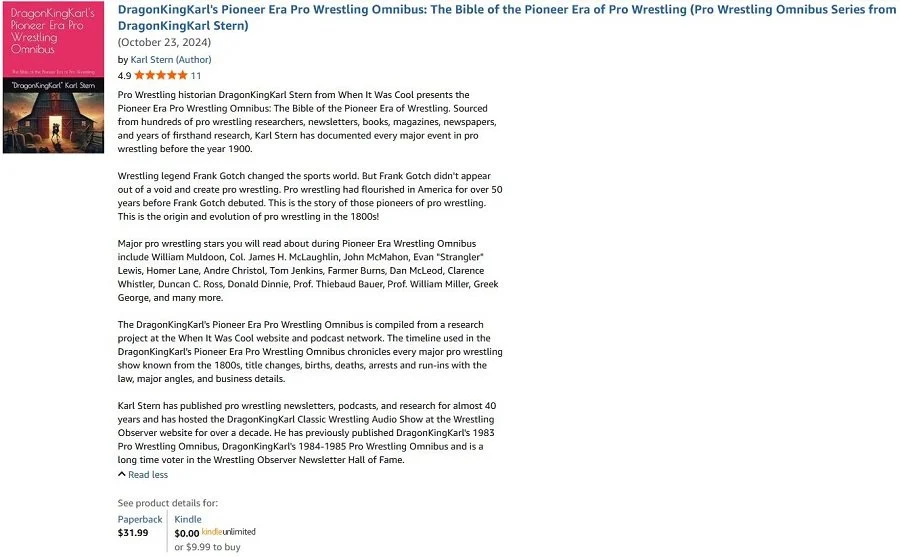

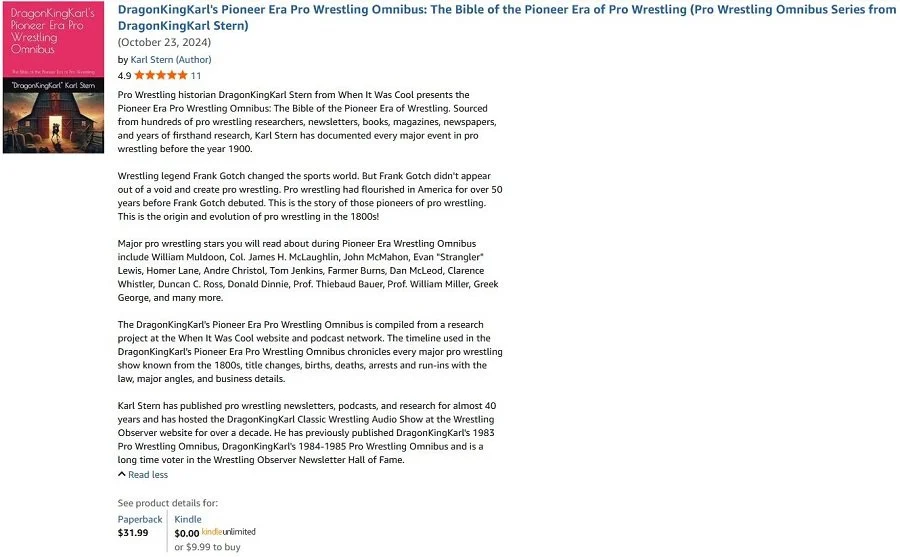
The following is taken from Author and Pioneer Era Pro Wrestling Historian Karl Stern’s book DragonKingKarl’s Pioneer Era Pro Wrestling Omnibus.
1832:
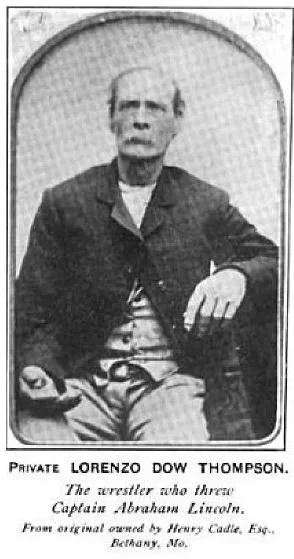
04-11-1832: According to the Beardstown, IL newspaper, Lorenzo Dow Thompson defeated Abraham Lincoln in two straight falls of wrestling. The following is an account of the match posted at an online forum by a poster named “RJ Norton” and is sourced from the article entitled "Captain Abraham Lincoln versus Private Lorenzo Dow Thompson" by Frank E. Stevens, appeared in "The Magazine of History with Notes and Queries" Volume 1, January- June , 1905. It was a New York-based history magazine, which began publishing in 1905, with the last issue in 1922.
The majority of the text is taken from an article entitled "Mr. Lincoln as a Wrestler", by Col. Risdon M. Moore. I have edited a few points for clarity and concision:
“While searching for material affecting the history of the Black Hawk War, I found the stereotyped version of the wrestling match between Captain Abraham Lincoln and an obscure private from the St. Clair company of Captain William Moore.
The match was celebrated, the State over, long before Lincoln became famous and it must be admitted a pleasure to turn from the serious man, to the early, robust Lincoln; the young man of stature and strength, informal as he was when just reaching man's estate and in possession of his first prize in life.
It may seem ridiculous to class the modest office of captain of a company of sixty day volunteers, as a proud position, yet Leonard Swett has told us the day of Lincoln's election to such a position in 1832, was the proudest of the latter's life.
When Governor Reynolds called out the militia to remove Black Hawk and his band from Illinois soil, "dead or alive," Abraham Lincoln enlisted. A company of sixty-eight intractable spirits (two more were added subsequently), was organized in Sangamon County and enrolled on April 21st, of which Lincoln was elected captain and from which he was expected to exact discipline.
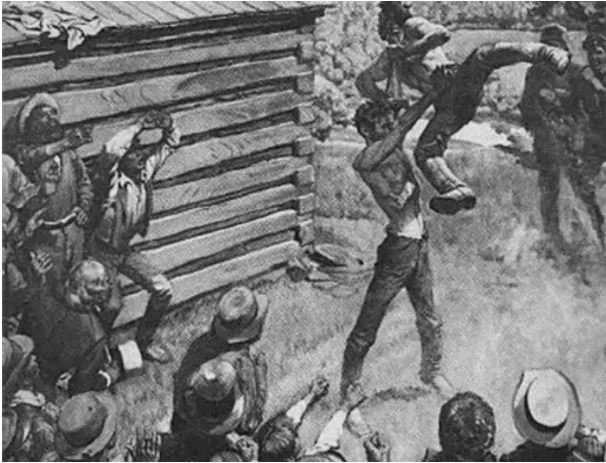
His [Lincoln’s] First Sergeant was John (Jack) Armstrong, the gentleman who had undertaken with disastrous personal results, to introduce Lincoln to New Salem "life" through the medium of a wrestling match.
DragonKingKarl Note: As we now know, the romanticized version of Abraham Lincoln’s wrestling match with Jack Armstrong was that Lincoln won, overwhelmingly, and this entered the popular culture of the time this was written. The actual facts were different.
William Kirkpatrick, said to have filched a cant-hook from Lincoln, as well as the latter's rival in the contest for captain, was another. The Clary boys, Royal and William, who acted disagreeable parts at the Armstrong function, were of the number, while as though smiling at the joke of it, "Pleasant " Armstrong was another private. Finally from the sentimental side we find the names of John M. and David Rutledge to add to the list. Truly a picturesque crowd!
Once organized, the company was marched to Beardstown to be sworn into the service of the State by Inspector General John J. Hardin, where too the captain fell in with such men as O. H. Browning, Edward D. Baker, Adam W. Snyder, John Dement, Gov. Carlin and others who became famous in the history of the State and Nation. At that point the companies were formed into regiments and moved toward "The Yellow Banks " en route for the mouth of Rock River where Captain Lincoln was to meet General Henry Atkinson, and Lieut.-Col. Zachary Taylor, as well as Lieutenant Robert Anderson, Lieutenant Jefferson Davis, Captain William S. Harney, Lieut. Albert Sidney Johnston and many others who were to be prominent in his future during the great crisis of our country.
At, or just out of Beardstown, the companies of Captain Lincoln and Captain William Moore from St. Clair County, came upon just such a camping ground simultaneously and for its occupation a strife arose of course. With the propensity for free fights, usual to those days, it may appear miraculous at this day that such an affray was avoided; but as Captain Lincoln felt his official oats at the time and may have desired to reap a little personal advantage from the collision, he proposed to Captain Moore that "captain for captain, the matter should be settled by a wrestling match." But as every rule of wrestling forbade a contest so unequal, Captain Moore, who declined, suggested as a substitute the selection of a man from each company. That appeared fair enough and with a metaphorical chip on his shoulder Captain Lincoln selected himself to represent his company, while Captain Moore who was not an authority on "wrestling form," turned over the function of selection to his brother, Jonathan Moore, Orderly Sergeant.
The latter knew his business even though a shout of derision went up from Lincoln's men when the champion was produced. When led up for slaughter, the victim was found to be just above medium height and weight and so unobtrusive and guileless that I had almost forgotten to mention his name: “Lorenzo Dow Thompson of St. Clair County. Captain Lincoln chortled and gave the upstart a look of such fine scorn that the poor fellow should have been sorry for living and had the affair been one of to-day we surely could have heard the captain shout" what a cinch! " when the books were opened for bets.
Jonathan Moore was called to referee the match which was to consist of "best two in three" falls. He tossed up a coin, winning the choice of "holts" [holds] for Thompson, who chose "side holt." Lincoln's was "Indian holt," and generally speaking it was a scrappy sort of a "holt" too. At once a great scramble followed among Lincoln's men to lay their bets before Captain Moore's men got "scart." [scared]
But Captain Moore's men refused to get "scart." In fact there was a very suspicious degree of firmness and unanimity in their opinion of Dow Thompson's ability to take care of himself and any loose change his friends might put up on him; so up went powder-horns, guns, watches, coats, horses, pay-rolls and reputations until there remained not one solitary article of property in possession or expectancy thereof which had not been put into the pot on that match.
To increase the zest of his men for gaming, Captain Lincoln who was cock-sure of victory, had urged them to offer odds and discount the future all they could, and the men did it. Then the combatants grappled "side holt" Thompson's choice.
They see-sawed. The spectators shouted. Momentarily Lincoln's men bantered Thompson with words of encouragement, "just to drag the sport out and get their money's worth," but when they discovered their error there appeared a temporary inspiration by the Clary boys to meddle. The Armstrong boys wanted to get busy as the contest proceeded, but before any of these meddlers could devise a plan, the long legs of the captain cleft the air and in the very next instant Thompson had him fairly upon the ground. The din which followed would have silenced a thunderstorm.
As said of the boy who fell down cellar: "he did not hurt himself, but did hurt his new pants, so it might be said of the chagrined captain after that first fall. His person had not been harmed but the disaster to his feelings was something dreadful. Particularly harmful because the crowd to witness it had quadrupled several times, each installment adding a few words of humiliation. Defeat in the presence of a few friends would have been dreadful, but surrounded by an army and he, a captain, it was a catastrophe. Even the swagger back to the center did not square it. His friends shouted: "That's only one fall, while two more are due." That encouragement did not place his confidence in the status quo. But he made his bluff by stating icily when he had secured his "holt" "Now Mr. Thompson, it's your turn to go down."
The Indian hug or "holt" did not work at all however. In fact the patronizing captain was kept busy trying to keep his feet solid against the multitude of tricks which Thompson had up his sleeve to thwart the captain's favorite "holt." At last it was abandoned as altogether useless.
The redoubtable captain followed with a "crotch-holt," but that terrible device was resisted as easily as water runs from a duck's back. A trick called "sliding away," was introduced, only to confirm the growing opinion of the spectators that the doughty wrestler from Sangamon had met his master.
A moment of indecision followed, the slipping of a mental cog, so to speak, just enough to allow the despised St. Clair man to get in his fine work, and once more the legs of the valiant captain rose in the air and both men fell to the ground in a heap.
"Dog fall!" [Not a clean fall] yelled Lincoln's men.
"Fair fall! " retorted Moore's men.
A free fight was imminent, but Lincoln, disgruntled and defeated though he was in one fall at least, was a "good loser." Springing to his feet before the referee could act, he cried : "Boys! The man actually threw me once fairly; broadly so, and this second time this very fall, he threw me fairly though not apparently so." That settled the matter and the frankness of the speaker saved him his reputation although his men had lost all their available property.
On the 8th day of August, 1860, Professor Risdon Marshall Moore, then of McKendree College (now of San Antonio, Texas), son of the referee, Jonathan Moore, called upon Mr. Lincoln at the latter's house in Springfield with a delegation of college men, devotedly attached to Mr. Lincoln's cause. In introducing Prof. Moore, Lieutenant Governor Koerner added, "of St. Clair County."
Prof. Moore then stated : "Mr. Lincoln, we have called to see the next President." To which Mr. Lincoln replied: "You must go to Washington to see the next President."
During this and other conversation which followed, Mr. Lincoln eyed Prof. Moore constantly with a suspicious twinkle of the eye, after which he asked: "Which of the Moore families do you belong to? I have a grudge against one of them."
Professor Moore replied with a still merrier twinkle : "I suppose it is my family you have the grudge against, but we are going to elect you President and call it even."
There were present at that meeting the same O. H. Browning who had witnessed the match nearly thirty years before, Norman B. Judd, Richard J. Oglesby and some others, to all of whom Mr. Lincoln related the story as herein told, concluding with these words : "I owe that Moore family a grudge, as I never had been thrown in a wrestling match until the man from that company did it. He could have thrown a grizzly bear."
Poor Thompson! He migrated to Harrison County, Missouri, and became its first representative in the General Assembly of the State in 1846 was re-elected in 1848. He was also a member of the first grand jury of the county. Politically he was called an anti-Benton Democrat. Positive in all his convictions, he was called eccentric toward the end of his life, but all who knew him testify that he was able, upright and a good neighbor and citizen.
In 1875 he died in indigence at the age of 65 and his body lies in Oakland cemetery six miles north of Bethany.