By: “DragonKingKarl” Karl Stern (Patreon)
Professional Wrestling Historian: Author of DragonKingKarl's Pioneer Era Pro Wrestling Omnibus

Franken-Castle: When Marvel Comics Turned the Punisher Into Frankenstein's Monster
There are certain things in comic books that seem inevitable. Spider-Man is always going to have problems. The X-Men are always going to be misunderstood. Batman is always going to be brooding over something. And Frank Castle, better known as the Punisher, is always going to be very, very angry.
But what happens when you take one of Marvel Comics' most violent, uncompromising, and thoroughly human vigilantes and turn him into a version of Frankenstein's Monster?
Well, you get one of the strangest, most controversial, and surprisingly entertaining stories in the history of Marvel Comics.
You get Franken-Castle.
As Halloween approaches here at When It Was Cool, we've been spending plenty of time revisiting Frankenstein and his many appearances throughout comic book history. We've explored how the famous monster found his way into the worlds of superheroes, and today we're looking at one of the most bizarre examples of that crossover.
Because in 2009, Marvel Comics decided that simply having the Punisher fight criminals wasn't enough. Instead, they killed him, stitched him back together, turned him into a hulking monster, and dropped him directly into the world of Marvel's supernatural creatures, and believe it or not, there's more to this story than an outrageous gimmick.
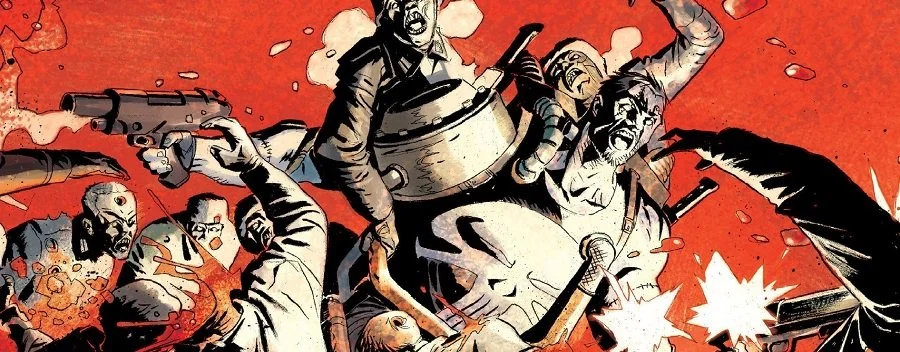
The Punisher Before Franken-Castle: Frank Castle Meets the Marvel Universe
To understand why Franken-Castle was so unusual, it's helpful to remember where the Punisher stood in Marvel Comics history. Frank Castle first appeared in The Amazing Spider-Man #129 in 1974, created by writer Gerry Conway with artists Ross Andru and John Romita Sr. involved in the character's visual development.
Originally introduced as an antagonist who believed Spider-Man deserved punishment, Castle eventually became one of Marvel's most recognizable antiheroes. Unlike superheroes with fantastic powers, Frank Castle traditionally relied upon military training, weapons, tactical planning, and an almost supernatural amount of determination. He was a former Marine whose family had been murdered, and he dedicated his existence to eliminating criminals.
Over the years, the Punisher became especially popular in gritty, street-level stories. His adventures often had more in common with crime thrillers and action movies than with conventional superhero comics.
The acclaimed Punisher MAX series, particularly the work of writer Garth Ennis, helped reinforce the character's reputation as one of the darkest figures in Marvel's publishing lineup.
However, Marvel has long maintained different approaches to the Punisher. The MAX version operated in a mature, largely self-contained crime-fiction environment, while the mainstream Marvel Universe version occasionally crossed paths with superheroes, supervillains, aliens, and supernatural threats. By 2009, Marvel's mainstream Punisher was about to have a very unfortunate encounter with Wolverine's son.
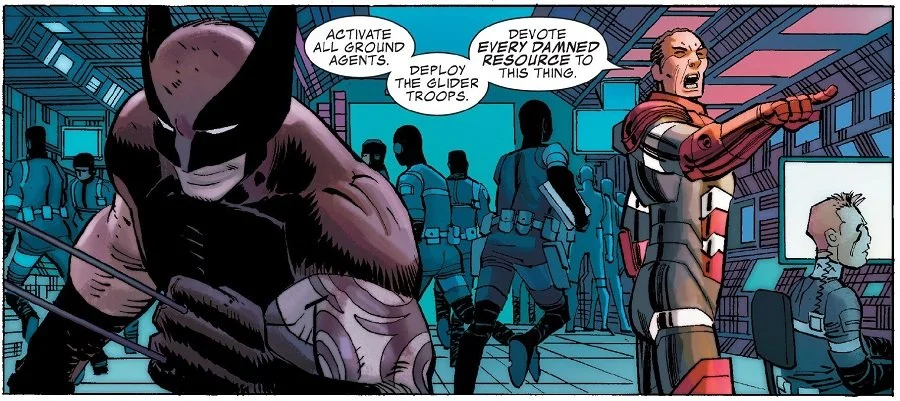
Dark Reign: The Death of the Punisher
Our story begins during Marvel Comics' Dark Reign era.
Following the events of Secret Invasion, Norman Osborn had emerged as one of the most powerful figures in the Marvel Universe. Yes, the same Norman Osborn who had terrorized Spider-Man as the Green Goblin was now operating with tremendous political and military influence. Frank Castle was not particularly impressed.
In fact, the Punisher decided that Norman Osborn needed to be eliminated. This brought Castle into conflict with Osborn's forces, ultimately leading to a disastrous showdown with Daken, the son of Wolverine. Daken possessed many of his father's abilities, including enhanced senses, extraordinary healing, and deadly claws. He was also exceptionally dangerous and had no particular objection to fighting dirty.
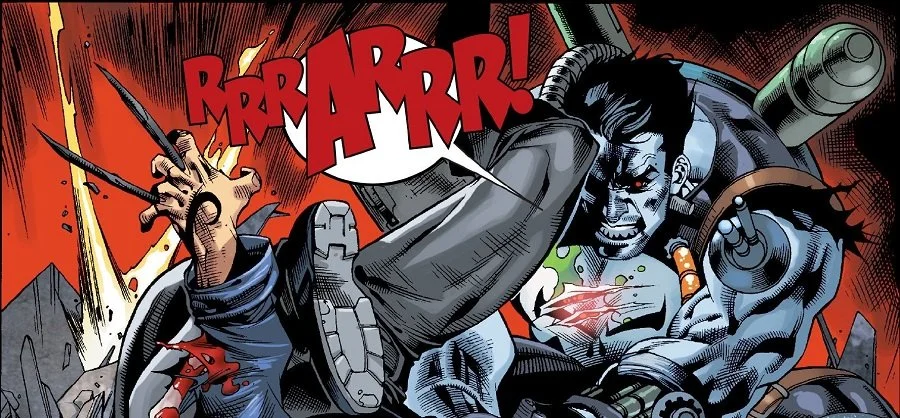
Their confrontation culminated in Dark Reign: The List – Punisher #1, published in 2009. Written by Rick Remender with artwork by John Romita Jr., the comic delivered one of the most shocking moments in Punisher history. Daken defeated Frank Castle in an overwhelmingly brutal battle, leaving the Punisher dead and his body in pieces.
For a character who had survived seemingly impossible situations for decades, it was a remarkably definitive-looking ending. Of course, this being the Marvel Universe, death has a tendency to be considerably less permanent than it is in the real world and Frank Castle's return would be stranger than almost anyone could have predicted.
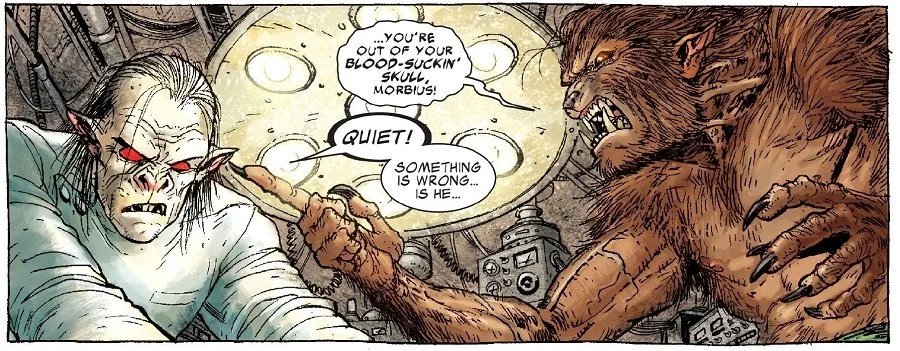
Enter Morbius and the Legion of Monsters
With Frank Castle dead, Marvel's supernatural community suddenly became involved.
Enter Morbius, the Living Vampire.
Morbius had been part of Marvel's horror tradition since his debut in The Amazing Spider-Man #101 in 1971. A scientist whose attempts to cure his own medical condition transformed him into a vampire-like creature, Morbius had spent decades existing somewhere between horror monster, tragic antihero, and reluctant superhero.
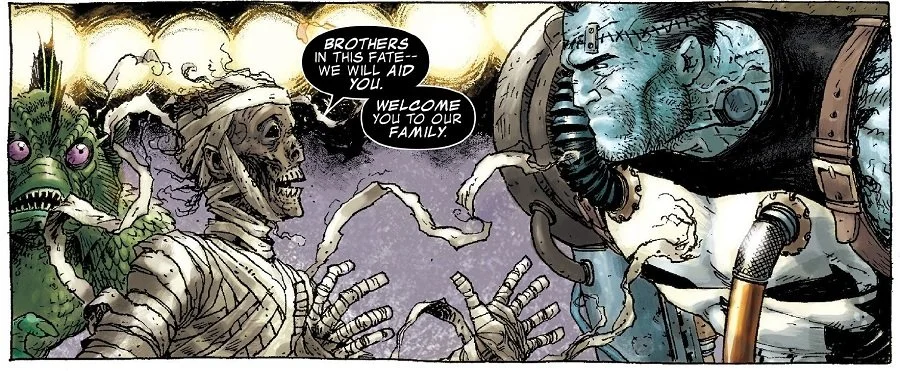
By the time of Franken-Castle, Morbius was connected with Marvel's Legion of Monsters, a group of supernatural characters who operated outside conventional human society. The Legion included some wonderfully obscure figures from Marvel's horror history, including Werewolf by Night, the Living Mummy, and Man-Thing.
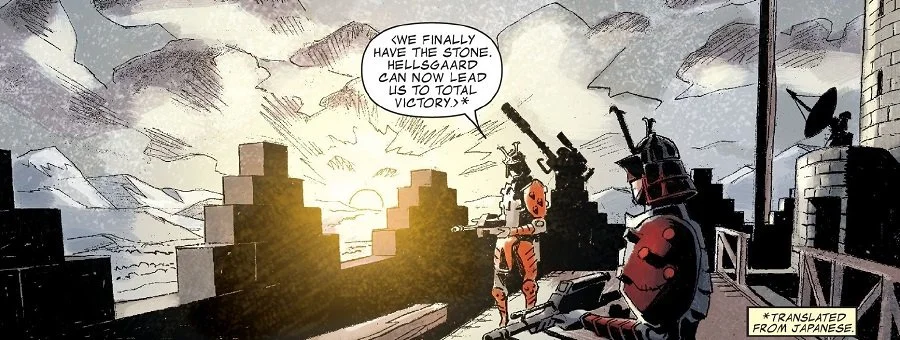
These were characters who represented Marvel's long-standing fascination with monster comics, particularly the company's horror output during the 1970s. And they had a serious problem. A fanatical monster hunter named Robert Hellsgaard was threatening their community. Hellsgaard viewed monsters as abominations and was determined to destroy them and the Legion needed someone ruthless enough to oppose him. Someone who understood relentless warfare. Someone like Frank Castle.
There was just one small complication. Frank Castle was dead.
Morbius, however, was a scientist, and in the Marvel Universe that can occasionally mean the distinction between life and death is negotiable. Using his scientific abilities and the resources available to the monsters, Morbius reconstructed Frank Castle's damaged body and brought him back to life. Not quite as he had been before.
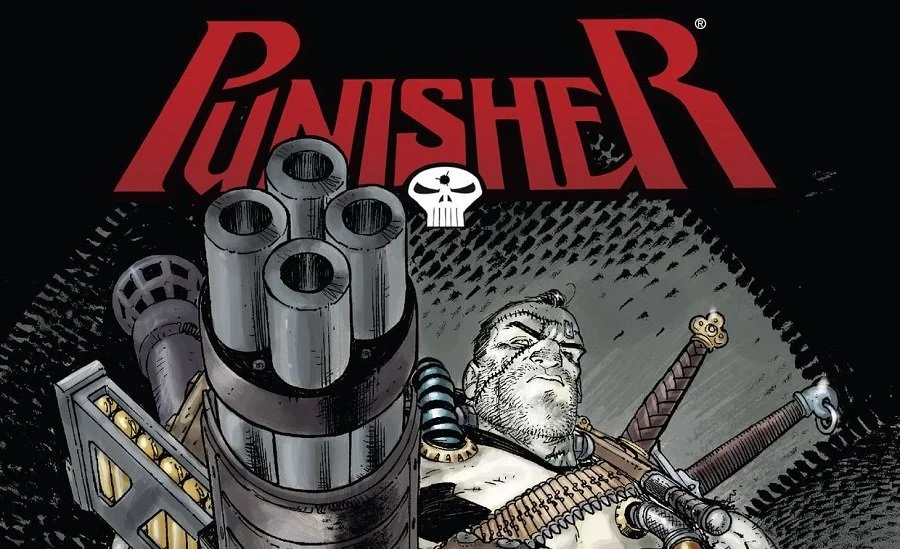
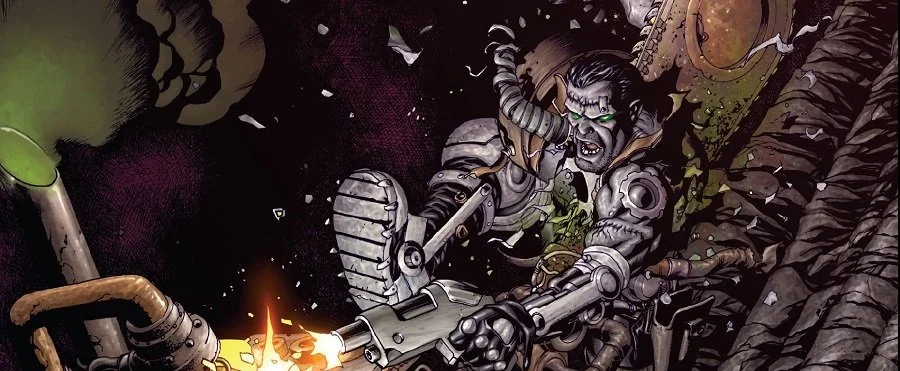
Frank Castle emerged as a massive, scarred, stitched-together creature with an appearance unmistakably inspired by Frankenstein's Monster.
The Punisher had become Franken-Castle.
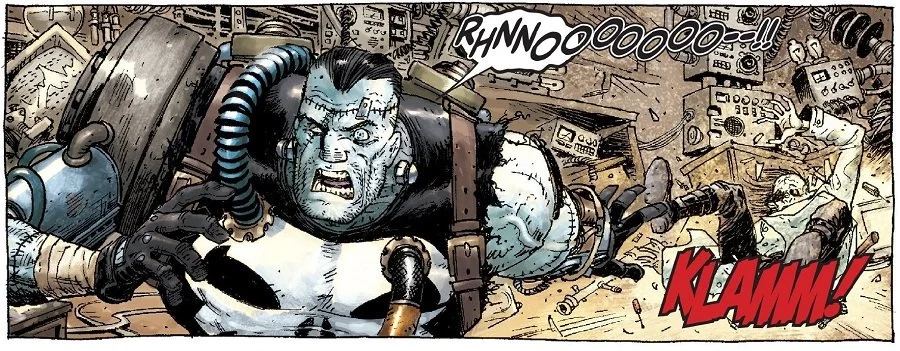
Franken-Castle: Marvel's Frankenstein Monster With an Attitude
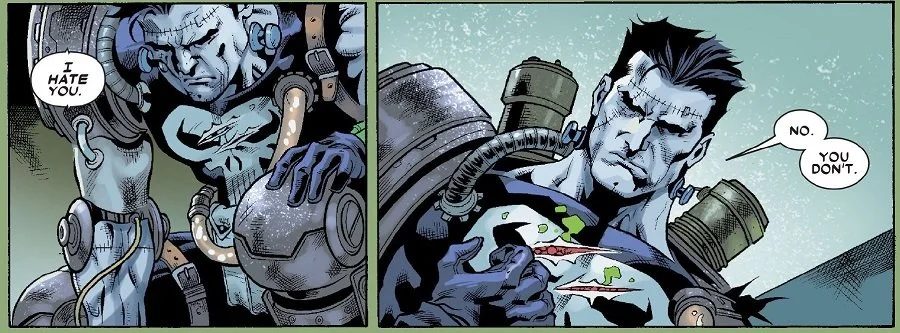
Visually, Franken-Castle was an extraordinary departure from the familiar Punisher. Gone was the relatively ordinary-looking man wearing a black shirt with a white skull emblem and in his place stood a physically imposing creature assembled from what remained of Frank Castle's body, sporting heavy stitching, mechanical enhancements, and the appearance of something that had escaped from a particularly ambitious mad scientist's laboratory.
Yet the most important thing about Franken-Castle was what had not changed. He was still Frank Castle. His memories remained intact. His personality remained largely intact. His brutal sense of justice certainly remained intact, and he was absolutely furious about what had happened to him.
The creative team understood that the inherent humor of the situation came from treating something utterly ridiculous with a reasonably straight face. Frank Castle wasn't suddenly cracking jokes or celebrating his new monster identity. He was still the Punisher, except now he looked like someone had assembled him out of spare parts in a castle laboratory during a thunderstorm.
It would have been easy to turn Franken-Castle into an outright parody. Instead, writer Rick Remender embraced the outrageous concept while maintaining the character's grim determination. The result was a strange combination of superhero action, horror comics, monster movies, and the kind of gloriously excessive storytelling that comic books sometimes do better than any other medium.
The Legion of Monsters and Marvel's Horror Heritage
One of the most enjoyable elements of the Franken-Castle storyline is its connection to Marvel's extensive library of horror characters. For readers interested in comic book history, that alone makes the storyline worth exploring. Marvel has a fascinating relationship with the horror genre.
During the early 1970s, the company enjoyed considerable success with supernatural titles such as The Tomb of Dracula, Werewolf by Night, The Monster of Frankenstein, and Ghost Rider.
Many of these characters appeared during an era when horror comics were enjoying renewed opportunities following changes to the Comics Code Authority's restrictions. Marvel's original Frankenstein's Monster, for example, starred in his own series beginning in 1973. The character drew inspiration from Mary Shelley's famous 1818 novel, Frankenstein; or, The Modern Prometheus, and the broader legacy of Frankenstein adaptations.
The Franken-Castle storyline draws upon that same heritage but adds a modern superhero twist. Morbius, Werewolf by Night, Man-Thing, and the Living Mummy aren't simply colorful guest stars. Their presence establishes an entire underground society of monsters with their own problems, fears, and motivations and, for once, these creatures aren't necessarily the villains. In fact, they're the ones facing extermination.
The storyline explores the idea that beings traditionally described as monsters can still possess loyalty, compassion, and a sense of community. Conversely, the supposedly righteous human hunting them can become the true threat.
Mary Shelley's original novel, after all, was never simply about a terrifying creature running loose. It concerned creation, responsibility, rejection, and the consequences of treating another being as something less than human.
Now, I'm not suggesting Franken-Castle is a profound literary adaptation of Mary Shelley. We're still talking about the Punisher running around as a stitched-together monster and fighting heavily armed enemies but there's a little more thematic substance here than the premise initially suggests.
And for a Halloween comic book story, that's a welcome bonus.
Franken-Castle Versus Robert Hellsgaard
The primary antagonist in this portion of the storyline is Robert Hellsgaard, a technologically equipped monster hunter with a personal vendetta against supernatural creatures. Hellsgaard leads a crusade against monsters and utilizes powerful armor and specialized weaponry in his campaign.
At first glance, he might seem like the sort of character Frank Castle would ordinarily respect. After all, Hellsgaard is obsessed with eliminating threats, possesses considerable combat resources, and approaches his mission with unwavering determination. However, The Punisher targets criminals because of the actions they have committed. Hellsgaard condemns entire groups of beings simply because of what they are. This creates an interesting moral conflict for Frank Castle.
Despite his new appearance, Frank is still capable of recognizing the difference between someone who has committed terrible crimes and someone who is merely feared or misunderstood. Consequently, the Punisher finds himself defending the very creatures that much of humanity would instinctively regard as monsters and considering the fact that he now resembles one himself, there's an obvious irony to the situation.
The battles are appropriately wild, combining military-style action with supernatural combat and bizarre comic book technology. It's precisely the sort of material that would have been completely out of place in the grounded Punisher stories of earlier decades. But in the exaggerated landscape of mainstream Marvel Comics, it works surprisingly well.
The Bloodstone and Franken-Castle's Strange New Existence
The storyline also incorporates another notable artifact from Marvel's supernatural mythology: the Bloodstone. Associated with the monster-hunting Bloodstone family, particularly Ulysses Bloodstone and his daughter Elsa, the Bloodstone possesses extraordinary mystical properties.
Its involvement adds another level of supernatural power to an already bizarre situation and helps connect Franken-Castle to the wider history of Marvel's monster-related characters. Rather than simply turning the Punisher into a generic Frankenstein creature, the writers surrounded him with concepts and characters drawn from decades of Marvel continuity.
This is part of what makes Franken-Castle such an interesting curiosity. It's simultaneously a Punisher story, a Frankenstein-inspired horror story, and something of a guided tour through Marvel's stranger supernatural corners. And because Frank Castle is deeply unhappy about nearly everything happening to him, his personality provides a consistent anchor for all the madness.
The Revenge of the Punisher: Franken-Castle and Daken
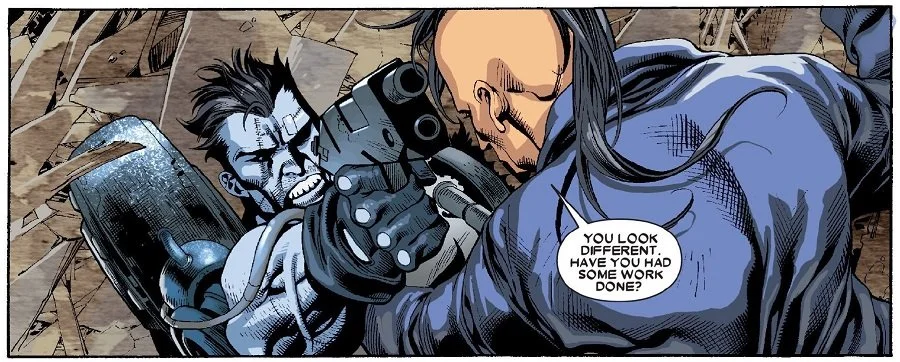
Of course, Frank Castle has never been particularly famous for forgiving people. And even after becoming Franken-Castle, he hasn't forgotten who put him in this condition. Daken remains a central figure in Frank's determination to settle old scores. The storyline eventually brings the characters back into conflict, culminating in a crossover involving Franken-Castle and Dark Wolverine.
The rematch provides an opportunity for Frank to confront the man responsible for his death and monstrous resurrection. But it also brings the Franken-Castle experiment closer to its conclusion. After spending time as a walking horror-movie creation, Frank ultimately returns to his familiar human appearance.
The transformation was not intended to replace the traditional Punisher permanently. Instead, it became one of the most unusual chapters in a character history already filled with strange twists. There is something wonderfully entertaining about the Punisher becoming Frankenstein's Monster, but eventually readers want Frank Castle back in his traditional role. Still, the sheer audacity of the storyline ensured that Franken-Castle would not be easily forgotten.
Was Franken-Castle a Good Idea?
Now we arrive at the obvious question. Was turning the Punisher into Frankenstein's Monster actually a good idea?
That depends entirely on what you want from your Punisher comics.
If you prefer Frank Castle as a grounded vigilante in realistic crime dramas, Franken-Castle probably isn't going to be your favorite storyline. It's about as far removed from the tone of Punisher MAX as you can possibly imagine. However, if you enjoy the strange and colorful history of Marvel Comics, it's hard not to appreciate the creativity involved.
Rick Remender and the artists working on the storyline, including Tony Moore, clearly embraced the horror influences rather than treating the material as something to be embarrassed about. And Marvel's superhero universe has always been capable of accommodating wildly different genres.
Spider-Man can fight common criminals one month and an interdimensional monster the next. Captain America can confront spies, mad scientists, and cosmic threats. The Avengers can battle everything from robots to ancient gods. Why shouldn't the Punisher occasionally become a Frankenstein-like creature?
Okay, granted, that's a fairly dramatic example of stretching the concept.
But comic books are supposed to be imaginative and sometimes the most memorable stories are the ones that take an established character completely outside their comfort zone. Franken-Castle certainly accomplished that.
Where to Read Franken-Castle: The Essential Marvel Comics
For anyone interested in revisiting this unusual piece of Marvel history, the core storyline originally appeared in the following publications:
Dark Reign: The List – Punisher #1 (2009): The shocking confrontation with Daken that sets everything in motion.
Punisher #11–16 (2009–2010): The beginning of the Franken-Castle storyline, including Frank's resurrection and involvement with the Legion of Monsters.
Franken-Castle #17–21 (2010): The series continues under its new title as the supernatural storyline progresses.
Dark Wolverine #88–89 (2010): The crossover involving Daken and the conclusion of Frank Castle's monstrous period.
The material has also been collected in trade paperback form, including volumes titled Punisher: Franken-Castle and related collected editions.
Because Marvel periodically changes the availability and organization of its digital and collected editions, readers should verify the contents of a particular collection before purchasing. For fans of classic horror comics and unusual Marvel storylines, these issues make a terrific Halloween reading selection.
Why Franken-Castle Is Perfect Halloween Reading
What makes Franken-Castle particularly appropriate for Halloween is the way it combines several generations of horror entertainment. At its foundation is the Frankenstein legend, one of the most influential stories in the history of science fiction and horror.
Layered over that is the tradition of old monster movies, particularly the image of the large, stitched-together creature brought back from death through unnatural scientific intervention. Then comes Marvel's own horror-comic tradition, with Morbius, Werewolf by Night, Man-Thing, and other supernatural figures stepping out of the shadows.
Finally, the entire thing is filtered through the personality of Frank Castle, one of the least likely characters imaginable to find himself starring in such an adventure. There's an old-fashioned comic book charm to this sort of outrageous premise.
It reminds me of an era when comic book covers could promise something utterly unbelievable, and readers would eagerly pick up the issue just to discover how in the world the writers intended to explain it. Imagine finding a comic book on the newsstand advertising that the Punisher had become Frankenstein's Monster.
How could you not at least take a look?
Final Thoughts: Franken-Castle Is a Marvel Horror Oddity Worth Remembering
Franken-Castle might not be the definitive Punisher storyline, but it is certainly one of the most unforgettable. By combining Frank Castle's relentless personality with Marvel's supernatural universe, the creative team produced a strange hybrid of action, horror, and classic comic book absurdity.
For longtime fans of Marvel's monster comics, the appearances of Morbius and the Legion of Monsters make the storyline especially rewarding. For Frankenstein enthusiasts, it's another fascinating example of how Mary Shelley's creation continues to influence popular culture more than two centuries after the original novel was published.
And for Punisher fans?
Well, it's proof that even death and resurrection as a stitched-together monster aren't necessarily enough to make Frank Castle reconsider his career choices.
Here at When It Was Cool, we love exploring these unexpected intersections of comic book history, horror movies, and pop culture nostalgia. Franken-Castle represents all three. It's weird. It's excessive. It's occasionally ridiculous and that is exactly why it's worth remembering.
Happy Halloween from When It Was Cool!
Support More Comic Book History at When It Was Cool
If you enjoy our deep dives into classic comic books, forgotten horror characters, vintage movies, professional wrestling history, and the wonderfully strange side of pop culture, please consider supporting When It Was Cool on Patreon.
Our Patreon supporters help make these features possible and support the continued preservation and discussion of pop culture history.
We also occasionally offer Patreon members early access to exclusive articles, special features, podcasts, and other content before they become available to the general public.
Join the When It Was Cool Patreon community and help us keep the history of pop culture alive!

If you found this article interesting, please consider becoming a Patreon supporter. That is how When It Was Cool keeps our website and podcasts online, plus you get lots of bonus content including extra podcasts, articles, ebooks, and much more. Check out our Patreon Page to see what's up!